

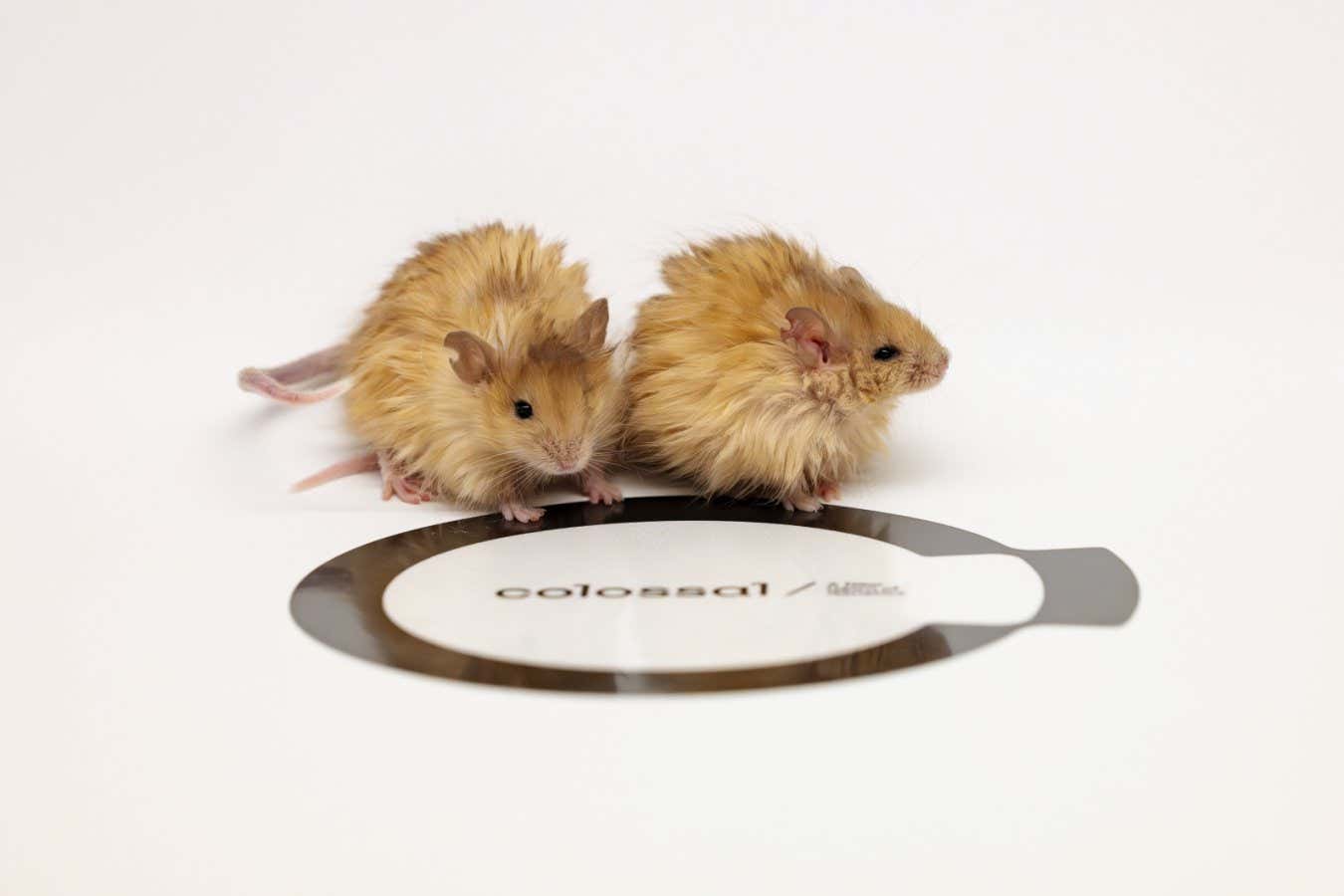
Mice that have been modified to give them a “mammoth-like” coat
Colossal
There are an estimated 1.5 million genetic differences between woolly mammoths and Asian elephants. Colossal Biosciences, the company aiming to resurrect the extinct species through genetic engineering, has now made mice with “mammoth-like” fur, each with up to five genetic changes. There is, it seems, still a way to go.
True, the fur of these mice is long, curly and blondish. In that way, it does resemble the coats of woolly mammoths preserved in permafrost. However, it isn’t clear that making the same genetic changes to Asian elephants – which have far fewer hairs per area of skin – would have similar results.
“The work done on these mice does not mean that there is a ready solution to bring back a mammoth phenotype,” says team member Love Dalén at Stockholm University in Sweden, who is on Colossal’s scientific advisory board. “As you point out, we also need to figure out how to make the fur grow more.”
Creating Asian elephants with these genetic changes will also be much harder than doing it in mice. “Engineering mutations in mice is a well-established process and not particularly challenging,” says Dusko Ilic at King’s College London.

A modified and unmodified mouse
Colossal
Techniques that work in mice often fail in other species, and the size of elephants and their slower reproduction will vastly increase the time and costs involved. “Those methods have not been developed for elephants and it won’t be easy just based on the anatomy,” says Vincent Lynch at the University at Buffalo, New York. “That is probably the biggest challenge.”
But Lynch has no doubt it is achievable. Indeed, Thomas Hildebrandt at the Leibniz Institute for Zoo and Wildlife Research in Berlin, Germany – another Colossal advisor – told New Scientist that his team has collected eggs from elephants for the first time, though the results haven’t yet been published. Egg collection is a key step in IVF and the genetic modification of mammals.
So how did Colossal make its “mammoth” mice? The researchers began by looking for known mutations in mice that make their fur look mammoth-like. “[T]he majority of these genes were selected based on previous observations of coat phenotypes in mice,” they write in a paper released today, which hasn’t been peer-reviewed.
They identified eight genes that affect the pattern (curliness), colour and length of hair when disabled in mice. Of these eight, one was naturally disabled in mammoths, according to Colossal.
From the mammoth genome, the team also identified a small mutation thought to affect hair pattern, along with another disabled gene involved in fat metabolism.
The company then tried altering these genes in mice. For instance, in one experiment, it tried using CRISPR gene editing to disable five of these genes in fertilised eggs. From 134 edited eggs, 11 pups were born and in one of these pups, both copies of the five genes were disabled.

Preserved fur on a frozen mammoth trunk
Alamy Stock Photo
In another study, the researchers used a form of CRISPR called base editing to disable several of the genes in embryonic mice stem cells. They combined this with another technique called homologous recombination to make the exact mutation found in the mammoth genome. Making precise changes is much harder than disabling genes – but the recombination method only works well in mice.
The team then sequenced the cells to identify ones with the desired changes and injected them into mice embryos to create chimeric mice. Of 90 embryos injected, seven mice with the four intended changes were born.
These experiments can be said to be successful in terms of producing some mice with the desired physical changes to their fur, but only one of the genetic changes exactly matches what is seen in the mammoth genome. A lot more work is needed to achieve Colossal’s stated aim of creating “a cold-resistant elephant with all of the core biological traits of the woolly mammoth” – and with elephant pregnancies lasting around two years, Colossal is running out of time to meet its self-imposed 2028 deadline.
“An elephant with a fur will not be a mammoth in the way we think of it,” says Juan Antonio Rodríguez at the University of Copenhagen, Denmark. Many of the 1.5 million differences between the genomes of mammoths and Asian elephants may have no effect, he says, but we don’t know for sure which ones do matter.
Even if we did, making more extensive changes is risky, says Rodríguez. “The more things you change in an organism, the more likely it is that you end up messing up with key metabolic pathways or genes.”
Rodríguez, Lynch and Ilic are all against bringing back the mammoth. Lynch reels off a long list of reasons why he thinks it is a bad idea, from the mammoths’ habitat no longer existing to the ethical aspects of trying to genetically modify elephants – even in humans, for instance, collecting eggs for IVF remains a risky and painful procedure.
“Mammoths are extinct and cannot be ‘de-extincted’ or resurrected,” says Lynch. “All they can do is make an elephant look like a mammoth.”
Topics:
