

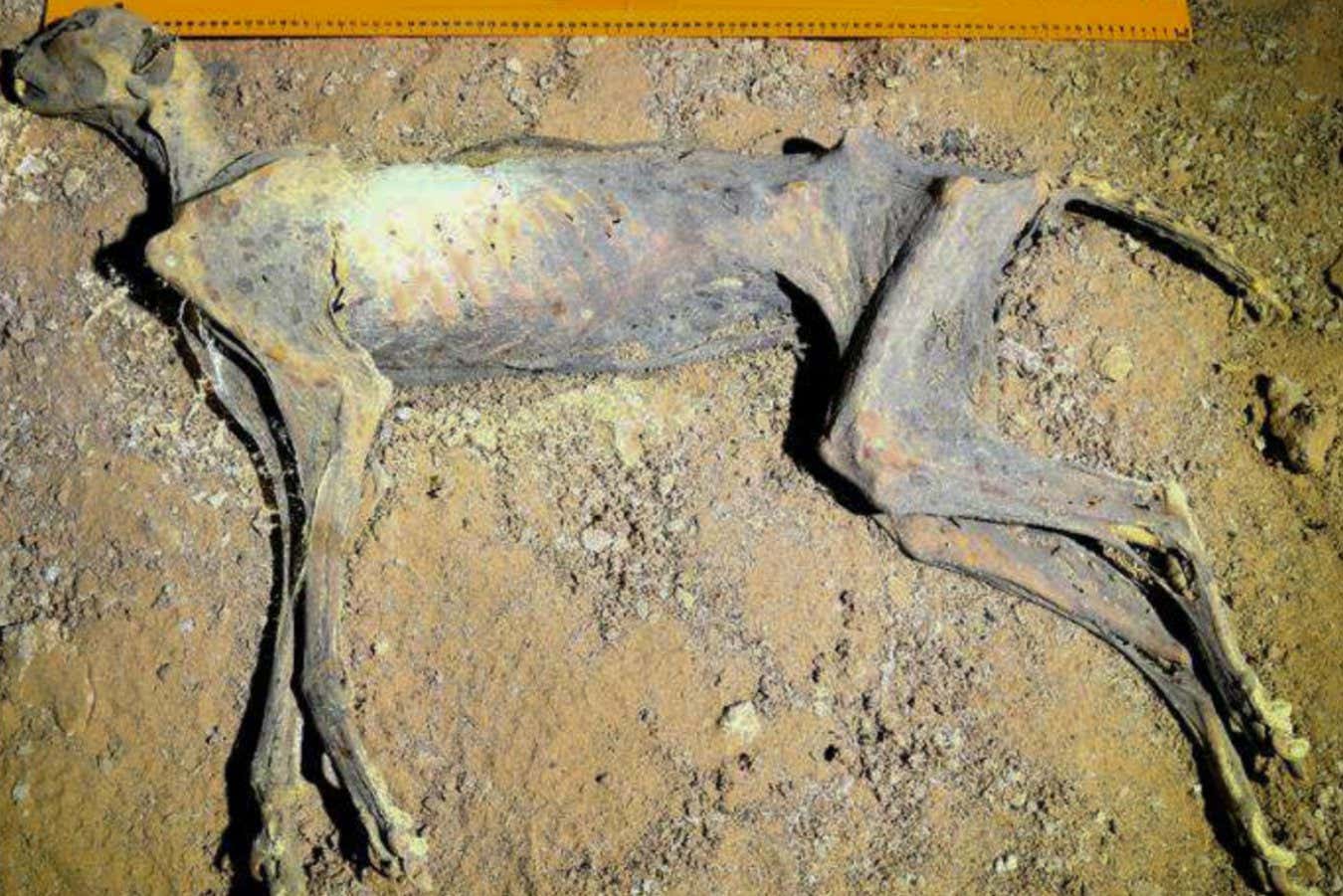
One of the cheetah mummies inside the cave it was found in
Ahmed Boug et al. 2025/National Centre for Wildlife, Saudi Arabia
The mummified remains of seven cheetahs, some dating back thousands of years, have been reported in caves in Saudi Arabia – the first naturally mummified big cats ever found by scientists.
Cheetahs (Acinonyx jubatus) have experienced a steep decline in numbers as a result of habitat loss, hunting and animal trade. They were eradicated from the Arabian peninsula decades ago, but Ahmed Boug at the National Center for Wildlife in Riyadh, Saudi Arabia, and his colleagues have now reported details of seven mummified cheetahs, and the skeletal remains of 54 others, which they found during surveys in the Lauga cave network in northern Saudi Arabia in 2022 and 2023.
The mummies – defined by the preservation of their soft tissues due to a halting of the decay process – date from between about 4000 and 100 years ago.
“The findings are truly remarkable,” says Anne Schmidt-Küntzel at the Cheetah Conservation Fund in Namibia. “In itself, the mummification of a felid is not entirely surprising, but it remains a first and, with that, a very important finding.”
“The relatively constant temperature and low humidity of the cave environments would have been conducive to the mummification process,” according to the researchers.
It is unclear why the cats were in the caves, as cheetahs aren’t known to use them as dens or to store carcases. None of the five caves they were found in contained a water supply when surveyed.
Many of the remains were discovered in just one cave, accessible by a sinkhole, so it is possible the cheetahs fell in and couldn’t get out, says Schmidt-Küntzel. The remains of other animals have also been found in the caves, including those of a wolf, striped hyena, gazelle and red fox.
When the researchers evaluated 20 of the complete cheetah skulls, they found that six were those of adults and the rest were from animals that were 6 to 24 months old. Other remains of nine cubs were also found in the main cave. The presence of so many young cheetahs hints that adult females may have been using the caves to shelter with them, says Schmidt-Küntzel.
Camera traps deployed during the survey revealed that they were being used by wolves. “This also suggests that several, if not all, of the caves were accessible during the cheetahs’ lifetimes and that the cheetahs could have deliberately entered them,” says Schmidt-Küntzel.
Although there is only one species of cheetah, there are four genetically distinct subspecies: the southeast African cheetah (Acinonyx jubatus jubatus), which is most common; the northeast African cheetah (Acinonyx jubatus soemmeringii) and the northwest African cheetah (Acinonyx jubatus hecki), which exist in smaller, fragmented populations; and the Asiatic cheetah (Acinonyx jubatus venaticus), of which there are very few individuals in Iran.
Boug and his team sequenced the genomes of three sets of the remains, which showed that the most recently mummified individual seemed to be most closely related to the Asiatic subspecies, as might be expected with Iran being the closest of the locations where cheetah subspecies are found in. But analysing two older samples, from 3000 and 4000 years ago, showed similarities to the northwest African cheetah, which suggests this subspecies was also present in the area then.
Schmidt-Küntzel says the work supports the idea that all cheetah subspecies could adapt to the same arid conditions, so they could be reintroduced to the area by breeding captive individuals from more numerous African subspecies.
Journey into Italy’s Central Apennines region for a fascinating introduction to the concept and practicalities of rewilding. Topics:
Conservation and rewilding in the Central Apennines: Italy
