

Technology Reporter
 Getty Images
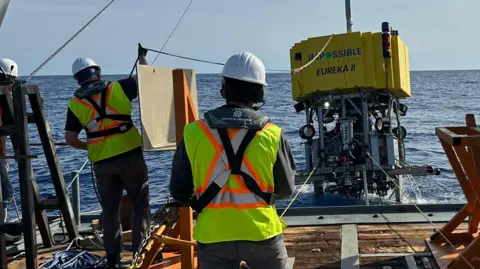
There’s one. And another. This robot was hunting for rocks. A three-pronged claw descended from above and plucked a stone off the seabed.
All the while, the autonomous machine’s on-board camera scanned for creatures that might be resting on those rocks, to avoid snatching an innocent lifeform from its habitat.
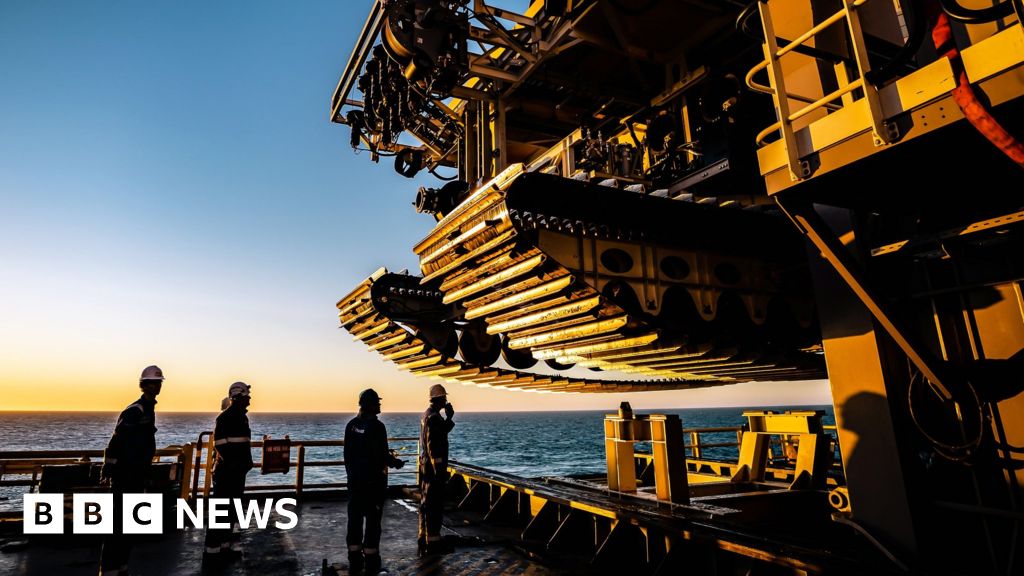
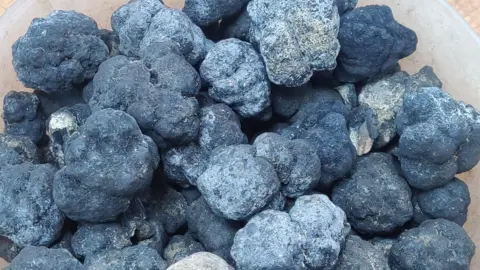
The test, carried out in a harbour in November, demonstrated one approach to mining for polymetallic nodules, potato-sized lumps containing metals scattered on the seabed in vast quantities, in much deeper parts of the ocean.
Such metals are sought-after for use in renewable energy devices and batteries, for example. But deep-sea mining is a controversial means of obtaining them because of its potentially significant environmental impacts.
“We felt that a vehicle that used AI to look for life and avoid it could have much less of an environmental footprint,” explains Oliver Gunasekara, co-founder and chief executive of Impossible Metals.
The firm’s system is 95% accurate at detecting lifeforms of 1mm or greater in size, he says.
The robot’s arms are similar to those that pick and place items in automated warehouses – they are optimised for speed. Plus, each claw kicks up a relatively small puff of sediment as it plucks its target off the seafloor. Impossible Metals aims to further reduce this disturbance.
Such a system is not likely to convince everyone that deep-sea mining is a good idea, however.
“Mining would by its nature remove the very substrate of life in and on the deep seafloor, no matter the technology,” says Jessica Battle, who leads the global no deep-seabed mining initiative at the WWF.
Deep-sea mining is highly controversial partly because the deep seabed is more or less untouched and still relatively poorly understood. “If you’re not sure what’s down there, then leave it alone,” says John Childs at Lancaster University. “That’s been the widespread position from science [to date].”
Scars left by mining experiments in the past, using highly disruptive technologies, have been severe.
In 1979, deep-sea mining equipment made large tracks in one part of the Pacific Ocean seabed and these remain there today, researchers say. Wildlife has reportedly still not fully returned to the area 40 years later.
Opposition to deep-sea mining has been fierce enough to scupper entire companies.
Nautilus Minerals sought to begin deep-sea mining work in the late 2010s. After protests and financial upsets, the company went bankrupt in 2019.
Minerals found on the deep seabed including manganese, nickel, cobalt, gold and silver are all considered important materials for the green energy transition.
Currently, such metals are sourced from mines on land, which themselves have a significant environmental impact.

 Impossible Metals
No commercial deep sea mining operations are underway today, though that could change this year if the first set of international regulations governing these activities is published, possibly in July.
Mr Gunasekara’s firm is currently building a larger version of its robot in a 20-foot shipping container, big enough to carry out commercial-scale operations. It will have 12 robot arms with grabbing claws.
He adds that “hundreds” of such bots would need to harvest the seabed at a time, bringing the spoils to a ship on the surface. The recovered nodules would then be transported to processing sites on land.
Unlike some other methods, in which heavy subsea equipment is tethered to support ships, Impossible Metals’ vessel would not have to remain in a precise spot for a long period, meaning its engines would not create as much noise. This would lessen the impact on wildlife, claims Mr Gunasekara.
He also argues that deep-sea mining would reduce the need for mining on land: “Anyone that doesn’t want to do deep-sea mining is implicitly saying we need to do more land-based mining.”
Jovana Jovanova at Delft University of Technology in The Netherlands is working on a different robot arm system that could gather metals from the seafloor. She stresses that those working in this field should seek to develop technology “in sync” with the environment.
Some deep-sea materials might be removed using more invasive methods, however. Seabed Solutions, a Norwegian firm, is working on a saw-based device to extract mineral-containing crusts or layers. The company says it is trying to reduce the volume of sediment disturbed by this process.
“You shield the cutting area and you ensure that it is under pressure,” says managing director Bård Brekke Jørgensen. “You have a suction head interface [on] your cutting tool.”
 Getty Images
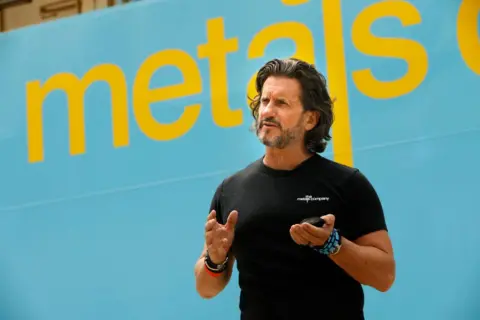
The Metals Company, a firm launched by former Nautilus Minerals investor Gerard Barron, is working on a different technique.
Mr Barron, chief executive, is bullish about the company’s prospects, despite the protests and lawsuits his firm has faced. Among the problems is a class action lawsuit filed by investors over the company’s reporting of proceeds from a partner company in 2023 – Mr Barron says “there’s absolutely nothing in it”.
Those calling for a moratorium on deep-sea mining are “virtue signalling” he says, adding that the new Trump administration in the US may help his company.
“We have many of our best supporters assuming very important roles in the new administration,” says Mr Barron.
The Metals Company intends to file an application for deep-sea mining in the Pacific Ocean with the International Seabed Authority (ISA) later this year. The ISA is yet to confirm how it would regulate such activities.
 The Metals Company
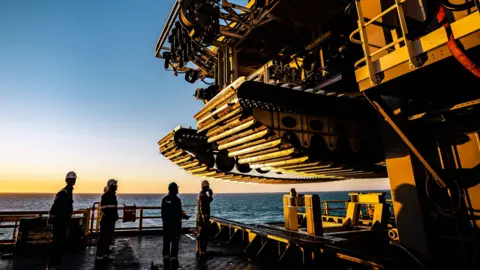
Dutch company Allseas, which is working with Mr Barron’s firm, has developed mining machinery for scooping polymetallic nodules off the seabed and sending them to a support ship on the surface.
The Metals Company’s own tests suggest that the debris plumes created by this process would spread for hundreds of metres from the mining area, rather than many kilometres, and that deposited sediment gradually clears over time.
Claims that sediment would be distributed many kilometres from the mining area were “total nonsense”, says Mr Barron.
Jeroen Hagelstein, a spokesman for Allseas, says his firm has adjusted the force of waterjets used to dislodge nodules in an attempt to minimise sediment disturbance.
Some sediment brought to the surface with the nodules gets dumped back into the ocean. Mr Hagelstein says his colleagues are considering whether to return it at a depth of three or four kilometres rather than discarding it at the surface, though he adds that this may require too much energy to adequately reduce the overall environmental impact.
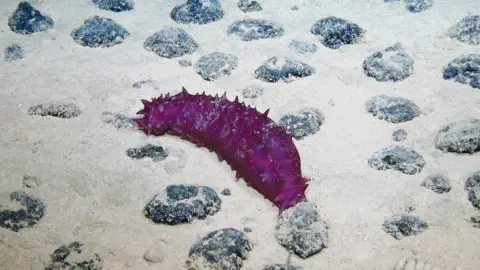
Mr Barron acknowledges that his firm’s machinery might affect lifeforms living on or around the nodules. “If you’re a sponge sitting on a nodule and we come and collect you, there will be an impact,” he says. Though he points out that many nodules would also be left behind.
 ROV KIEL 6000/GEOMAR
Ann Vanreusel at Ghent University has studied deep-sea wildlife. She says the sought-after polymetallic nodules are themselves home to some creatures, which use them as a substrate. So even if mining machinery created zero sediment disturbance, pollution and noise, removing nodules would still impact the ecosystem.
Dr Childs also mentions the importance of the deep sea to many indigenous cultures. Mining could interfere with this, he suggests.
And there’s another issue. The market for metals metals sought by deep-sea mining firms is notoriously volatile, meaning the business case for deep-sea mining may not be as strong as some hope, says Lea Reitmeier at the London School of Economics.
“When you delve deeper into it, and you look at which minerals actually have supply shortages, I’m not sure that adds up,” she says.
