

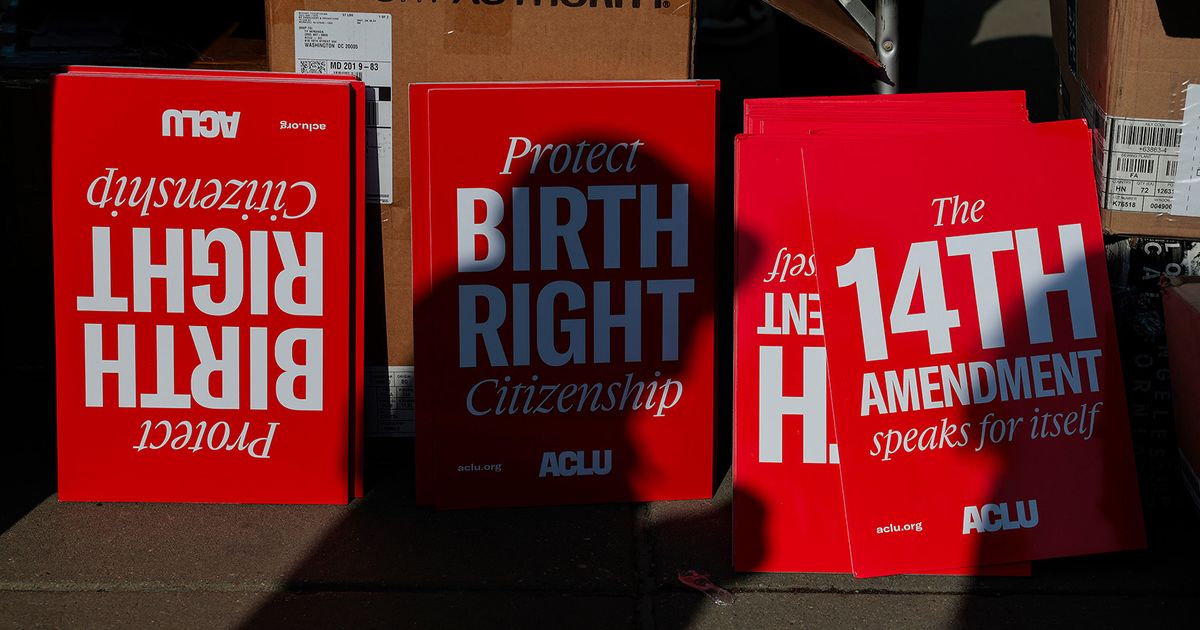
The good news about the landmark birthright citizenship decision the Supreme Court issued Tuesday is that it correctly holds that children born in the U.S. automatically become citizens. That’s the right interpretation of the 14th Amendment and reaffirms the 1898 precedent that the president tried to upend with his executive order purporting to deny citizenship to children of undocumented people.
The bad news — and it is very bad — is that the vote in support of this position was 5 to 4, not 9-0. The majority opinion was written by Chief Justice John Roberts, who was joined by Justice Amy Coney Barrett and the court’s three liberal justices: Sonia Sotomayor, Elena Kagan and Ketanji Brown Jackson.
You read that right. The highest court in the United States came within a single vote of casting aside the text and history of the 14th Amendment and joining the anti-immigrant frenzy that accompanied President Donald Trump to the White House nine years ago and has not yet fully abated.
As of today, the bloc of four conservatives who would have gone full Trump deserve to be called “the Four Horsemen.” On the court, the nickname goes back to the 1930s, when journalists evoked the Bible’s Four Horsemen of the Apocalypse as a way of describing the four hardcore conservative justices who blocked progressive legislation for years.
Justices Clarence Thomas, Samuel Alito, Neil Gorsuch and Brett Kavanaugh would make their horsemen predecessors proud. Like them, they ride roughshod over the language of the Constitution, not to mention precedent. Their path is determined by their ideological preferences, even as they insist it is based on their constitutional respect.
The ideological lockstep of the horsemen’s charge is demonstrated plainly by comparing them to Roberts and Barrett. Both the chief justice and the court’s youngest justice are extremely committed, lifelong jurisprudential conservatives. Both have joined the rest of the conservative majority in important cases where their principles dictated that they do so — such as the case that reversed Roe v. Wade in 2022 or, just this week, in neutering independent agencies under the theory of the unitary executive.
But Roberts and Barrett are jurisprudential conservatives who seek to apply the Constitution consistent with their conservative jurisprudence. When jurisprudence and contemporary conservative ideology conflict, they go with the jurisprudence — the way the late Justice Antonin Scalia tried to do, and usually did. That’s why they voted to uphold birthright citizenship: not because they like it or don’t like it, but because it’s in the Constitution and is supported by history, language and precedent.
In the birthright citizenship case, which Alito called “one of the most important decisions in the history of the Court,” the Four Horsemen produced three dissents among them.
Each offers a different rationale for the same outrageous conclusion. But all agree that the opening words of the 14th Amendment don’t mean what they plainly say. The text reads: “All persons born or naturalized in the United States, and subject to the jurisdiction thereof, are citizens of the United States.”
According to the four conservative dissenters, Congress could redefine the words “subject to the jurisdiction thereof” so that people not lawfully in the U.S. are excluded. Yet everyone in the United States, lawfully or otherwise, is plainly subject to the jurisdiction of the United States. All of us here are obligated to follow U.S. laws and can be punished criminally if we don’t do so.
The Four Horsemen are supposed to take the text of the Constitution seriously. So how could they vote the way they did, ignoring the words of the 14th Amendment and rejecting the straightforward majority opinion that also relied on both history and precedent?
The short answer is that they have talked themselves into positions that coincide with contemporary conservative political ideology. Following the principles of conservative jurisprudence as expressed by Scalia, whom they all claim to admire, would have led them to join the majority opinion. In a conflict between principled constitutional interpretation and political ideology, they chose the ideological route.
As Roberts’ majority opinion demonstrates, the definition of citizenship that Americans inherited from Britain and the common law included everyone born in a place where the king’s dominion extended. Children of foreign ambassadors could be exempted because of the legal fiction that they were on their home soil while serving as diplomats. Native Americans were treated as members of sovereign nations who therefore had a claim not to be under U.S. jurisdiction.
Everyone else born in the U.S. was a citizen, at least until the notorious Dred Scott decision in 1857, in which the Supreme Court held that Americans of African descent did not and could not count as citizens. After the Civil War, the 14th Amendment was enacted with the explicit goal of overturning Dred Scott and re-including African-Americans alongside everyone else.
In a dissent joined by Gorsuch, Thomas tried to argue that the 14th Amendment was only aimed at affirming citizenship by birth for Black people. Jackson, who has repeatedly tussled with Thomas on race questions, wrote a separate concurrence. She noted the irony that Thomas, who believes the 14th Amendment demands a race-blind Constitution, would want to read the same amendment to apply narrowly to African Americans.
Kavanaugh, who in highly ideological cases has tragically suppressed his own laudable impulse toward judicial restraint, offered a tenuous argument about why the court shouldn’t be bound by the 1898 case that interpreted the 14th Amendment to mean that the Chinese son of guest workers became a citizen by being born in the U.S. Although he agreed with the majority that the president’s executive order was unlawful, his argument was that only Congress, not the president, could make or reverse exceptions to birthright citizenship.
Alito’s strange dissent correctly noted that, before the modern era, “the distinction between citizens and aliens meant less than it does today.” But instead of concluding that we should consequently respect the sweeping language of the 14th Amendment, he fulminated against what he called “birth tourists” and insisted that including all people born in the U.S. as citizens had the effect of “degrading” citizenship.
Alito is right about one thing: This birthright citizenship case is historic. And history will show that, under pressure, the Supreme Court managed to do the right thing on citizenship. It will also show that the Four Horsemen did everything they could to serve ideology rather than jurisprudential principle.
