

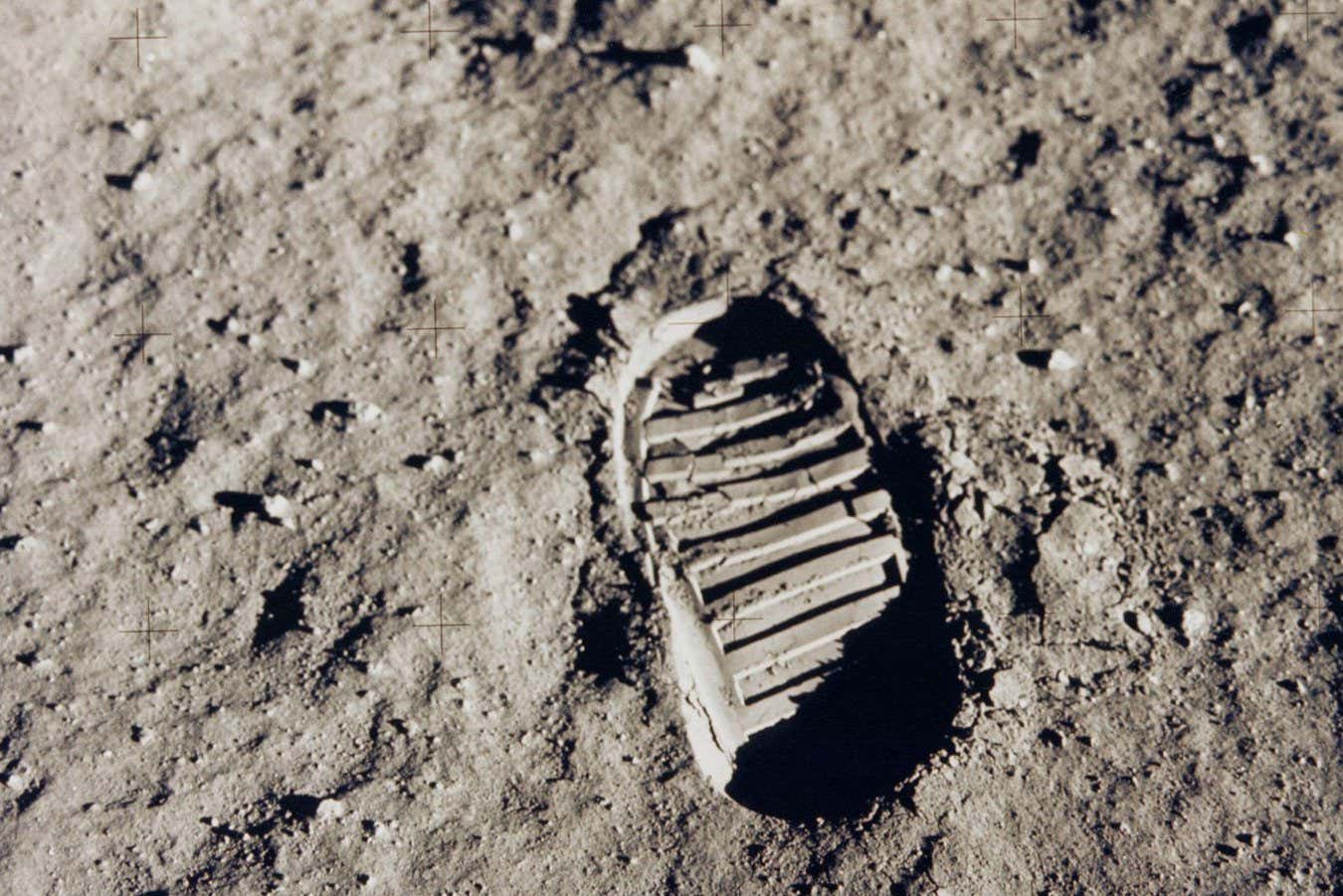
A boot print on the dusty surface of the moon
Public domain sourced / access rights from CBW / Alamy
Future lunar bases could be powered by solar cells made on-site from melted moon dust.
Building items on the moon, using materials that are already there, would be more practical than shipping them from Earth. When Felix Lang at the University of Potsdam in Germany heard about this idea, he instantly knew what to do. “It was like, ‘We have to make a solar cell like this, immediately’,” he says.
Two years later, Lang’s team has built and tested several solar cells featuring moon dust as an ingredient. The other key component is a crystal called halide perovskite, which contains elements such as lead, bromine and iodine, alongside long molecules of carbon, hydrogen and nitrogen.
The team melted a synthetic version of lunar regolith – the layer of loose rocks and dust that blankets the moon – into “moonglass”, which they then layered with the crystal to complete a solar cell. They did not purify the regolith, so the moonglass was less transparent than materials in conventional solar cells. But Lang says that the team’s best prototypes still reached about 12 per cent efficiency. More conventional perovskite solar cells typically reach efficiencies close to 26 per cent; Lang says computer simulations suggest his team could reach that number in the future.
In general, researchers agree that perovskite solar cells will outperform the more traditional silicon-based devices, both in space and on Earth. From the lunar standpoint, using perovskite materials is also attractive because they can be kept very thin, which would reduce the weight of the material to be transported to the moon. According to the team’s estimates, a solar cell with an area of 400 square metres would require only about a kilogram of perovskite. This is an impressive claim, says Ian Crawford at Birkbeck, University of London.
Not having to purify the regolith is similarly important, as it means that no special reactors would be necessary. In fact, Lang says that a large curved mirror and sunlight could create a beam of light warm enough to make moonglass. One of his colleagues already tested this technique on the roof of their university and saw some signs of regolith melting, he says.
Nicholas Bennett at the University of Technology Sydney says that, while past studies tried to process lunar regolith into transparent glass, this is the first time that a solar cell has been shown to work instead with the less finicky moonglass. The challenge now, he says, is to make lots of moonglass outside the lab. If successful, such melting technology could help create other items a lunar base may need, like tiles, says Crawford.
Michael Duke at the Lunar and Planetary Institute says that manufacturing moonglass-based solar cells will require many technological advancements, from excavating regolith to connecting individual cells into arrays. Still, if a solar cell factory were ever established on the moon, it could have positive knock-on effects. In this future, space-based systems like satellites could use moon-made solar cells instead of those created on Earth, because launching payloads from the moon requires less energy, he says.
Lang and his colleagues are now working on increasing their solar cells’ efficiency. For instance, they are working out whether they can improve the quality of their moonglass by using magnets to pick out iron from the regolith before melting it.
Ultimately, they want to expand the process to other dusty denizens of space. “We are already thinking, ‘Can we make this work with Mars regolith?’” Lang says.
Topics:
