

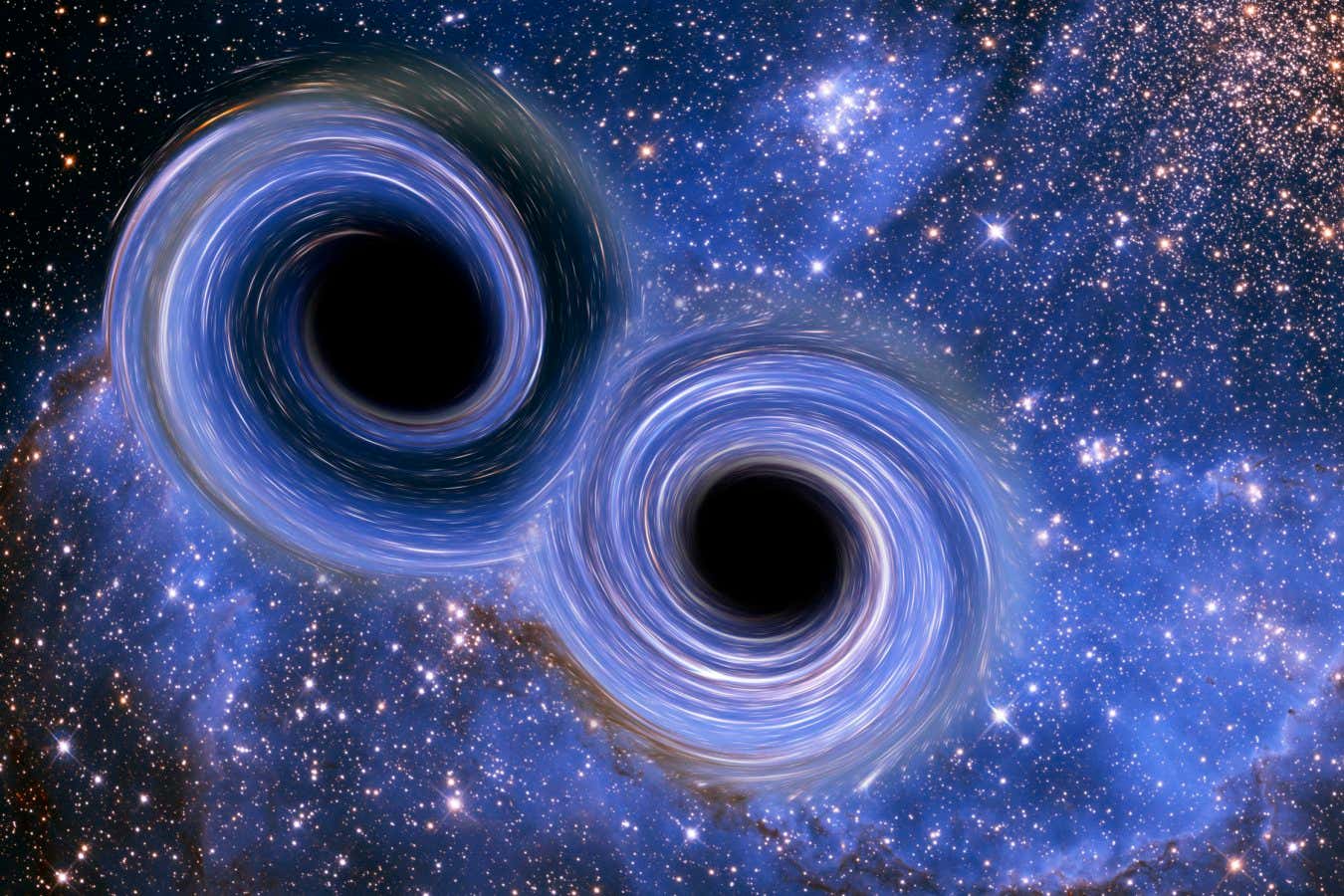
Black holes produce gravitational waves when they collide
VICTOR de SCHWANBERG/SCIENCE PHOTO LIBRARY
Efforts to understand the universe could get a boost from an AI developed by Google DeepMind. The algorithm, which can reduce unwanted noise by up to 100 times, could allow the Laser Interferometer Gravitational-Wave Observatory (LIGO) to spot a particular type of black hole that has so far eluded us.
LIGO is designed to detect the gravitational waves produced when objects such as black holes spiral into each other and collide. These waves cross the universe at the speed of light, but the fluctuations they cause in space-time are extremely small – 10,000 times smaller than the nucleus of an atom. Since its first observations 10 years ago, LIGO has recorded such signals produced by nearly 100 black hole collisions.
To do so, the experiment consists of two observatories in the US, each with two arms 4 kilometres long that are set perpendicular to each other. Lasers are beamed down each arm, reflected by precise mirrors at the end and then compared using an interferometer. The length of the arms is changed by a tiny amount as gravitational waves wash over them, and this is carefully recorded to build a picture of the origin of these signals.
The problem is that such demanding accuracy is required that even distant ocean waves or clouds passing overhead can affect measurements. This noise can easily drown out signals, making some observations impossible. Dozens of major adjustments need to be made to filter out the worst of this noise, tweaking the orientation of mirrors and other equipment.
Rana Adhikari at the California Institute of Technology in Pasadena, who worked with DeepMind to develop the new AI technology, says that attempting to automate these adjustments can ironically create more noise. “That controls noise has been bedevilling us for decades and decades – everything in this field has been blocked,” says Adhikari. “How do you hold the mirrors so still without inducing noise? If you don’t control them, the mirrors swing all over the place, and if you control it too much, then it sort of buzzes around.”
Laura Nuttall at the University of Portsmouth in the UK was one of the scientists who used to manually make these tweaks at LIGO. “As you move one thing, something else goes, and something else goes and something else goes,” she says. “You’d spend forever tweaking.”
DeepMind’s new Deep Loop Shaping AI aims to reduce the level of noise from adjusting the mirrors at LIGO by up to 100 times. The AI was trained in a simulation before testing in the real world, and is effectively tasked with achieving two goals: reducing noise and minimising the number of adjustments it makes. “Over time, by repeatedly doing it – it’s like hundreds and thousands of trials that are running in simulation – the controller will sort of find what works and what doesn’t work and find a really, really good policy,” says Jonas Buchli at DeepMind.
Alberto Vecchio at the University of Birmingham, UK, who wasn’t involved in the research but works on LIGO, says the AI is exciting, although there are many hurdles yet to overcome.
Firstly, the technology has only been run for an hour in the real world on LIGO, so it needs to be shown that it can operate for weeks or even months at a time. Secondly, the technology has so far only been applied to one aspect of control, helping to stabilise the mirrors, and there are hundreds if not thousands of aspects it could conceivably be applied to.
“It’s clearly just the first step, but I still think it’s a very intriguing one. And clearly there is plenty of room for enormous progress,” says Vecchio.
If similar improvements could be made across the board, then he believes we could spot so-called intermediate-size black holes – for example those with masses around 1000 times that of our sun – a class of objects without any confirmed observations. The improvements would tend to occur on lower-frequency gravitational waves, where the length of wave is more susceptible to noise, and which are created by larger objects.
“We know black holes up to 100 solar masses. We know the black holes in our galaxy that are a million solar masses and above. What’s in between?” says Vecchio. “People think there will be black holes at all these different mass ranges, but nobody has got uncontroversial experimental observational evidence.”
Nuttall says that the new approach could also provide more detailed observation of the types of black hole we have already seen. “This is looking pretty damn good,” she says. “I’m super excited by this.”
Topics:
