

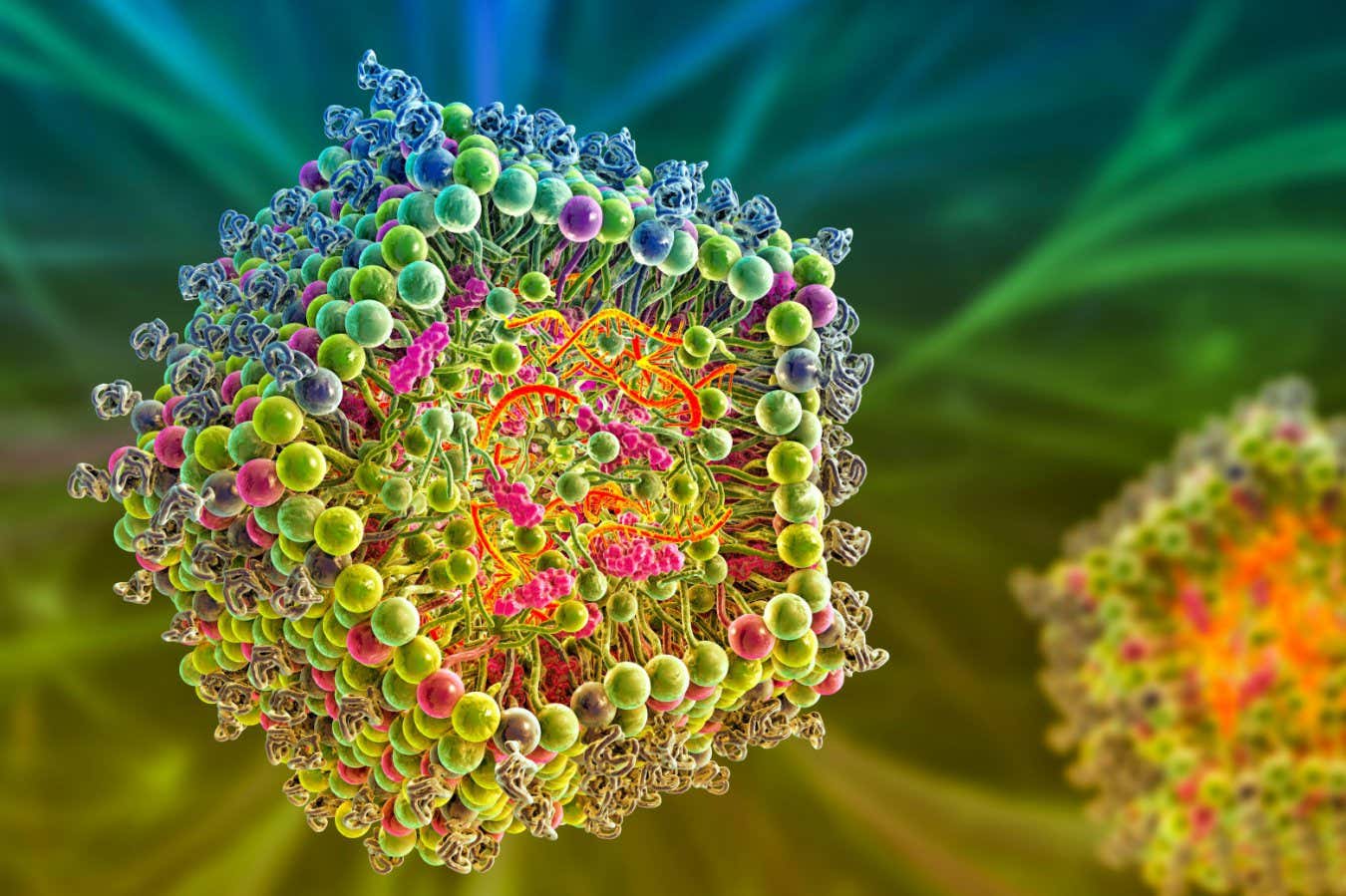
A computer illustration of a cross-section of a lipid nanoparticle carrying the mRNA of a virus (orange strands)
Science Photo Library / Alamy
Vaccines that resemble viruses generally produce a stronger immune response, while mRNA versions are much quicker and cheaper to make. Now we are getting the best of both worlds, in the form of mRNA vaccines that code for virus-like nanoparticles, rather than just individual proteins, as is the case with existing covid-19 mRNA vaccines.
Grace Hendricks at the University of Washington in Seattle and her colleagues have shown that an mRNA version of a covid-19 nanoparticle vaccine produces an immune response in mice that is up to 28 times higher than that of a standard mRNA vaccine.
Some of the unpleasant – but mild – side effects of mRNA vaccines stem from the body’s immediate reaction to injected mRNAs and the fatty particles in which they are enclosed, says Hendricks. With more potent vaccines, the dose could be lowered. “So the important immune response stays the same, but the side effects would be lower because you gave a smaller dose,” she says.
The first-ever vaccines consisted of weakened “live” viruses, which are very effective but can be risky for people with weakened immune systems. Then came inactivated vaccines containing “dead” viruses, which are safer but tricky to manufacture.
The next advance was protein subunit vaccines, which typically contain just the outer proteins of viruses. These are even safer than inactivated vaccines, but free-floating proteins tend not to produce a strong immune response.
So, vaccine designers started embedding the viral proteins in tiny spheres to create spiky balls that look like a virus to the immune system, but are just as safe as protein subunit vaccines. One way to do this is to modify existing proteins so they self-assemble into tiny balls, with the viral proteins protruding from them, known as vaccine nanoparticles.
During the pandemic, colleagues of Hendricks created a covid-19 nanoparticle vaccine called Skycovion. It was approved in South Korea in 2022, but by then, the mRNA vaccines had already had a big head start, so it wasn’t widely used.
mRNA vaccines are much quicker and easier to manufacture than protein-based vaccines because they consist of the recipes for making proteins, and cells in our bodies do the hard part of making these proteins. The viral proteins encoded by the first-generation mRNA vaccines end up protruding from the outside of cells and produce a better immune response than free-floating proteins, but not as effective as nanoparticle vaccines.
Now, Hendricks and her colleagues have combined the advantages of both approaches by creating a vaccine consisting of mRNAs coding for Skycovion. When the vaccine proteins are made inside cells, they assemble themselves into the nanoparticles, with signs of efficacy in the study in mice.
“This was just proof of concept of this genetic delivery,” says Hendricks. She and her colleagues are already working on mRNA-launched nanoparticle vaccines, as they call them, against flu, Epstein-Barr – which can cause cancers – and other viruses.
“I am enthusiastic about the promise of mRNA-launched protein nanoparticles for vaccines,” says William Schief at the Scripps Research Institute in California, who is developing HIV vaccines. “My collaborators and I have published fantastic immunogenicity results with two mRNA-launched nanoparticles in clinical trials and several such nanoparticles in mouse models. This new paper adds nicely to the body of work.” But despite the potential of mRNA vaccines, the US recently announced big cuts in funding for their development.
Topics:
