

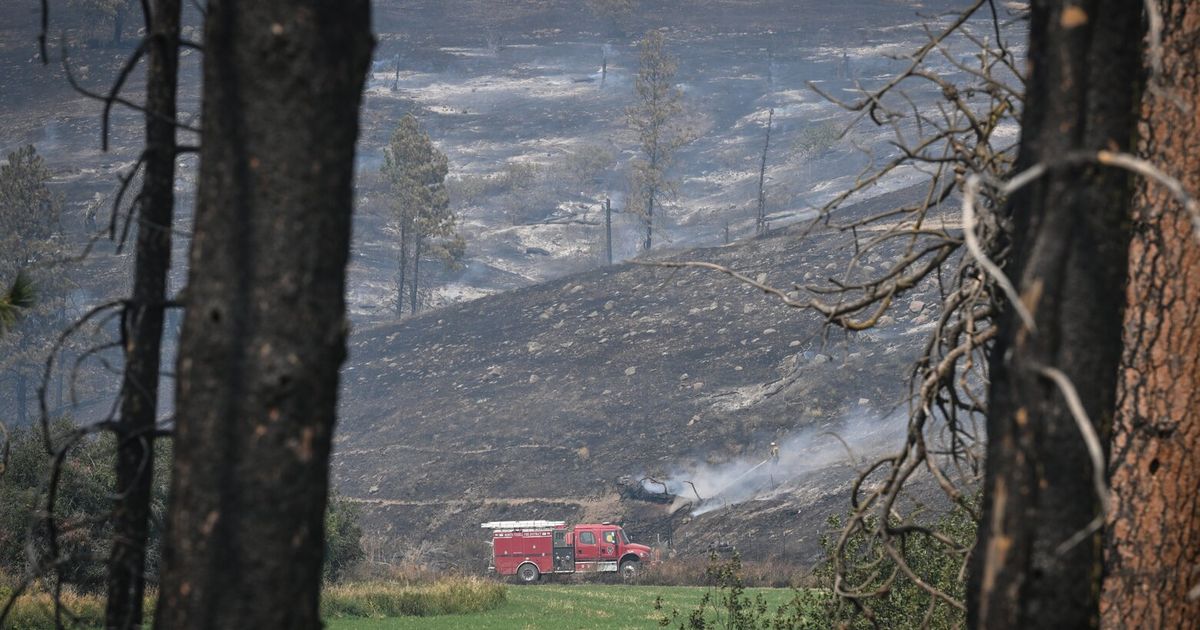
I drove into the Horse Heaven Hills on a recent Saturday morning to view the devastation wrought by our latest rash of wildfires. I parked just above the intersection of South Olympia St. and SR-397, and got out to take videos. I hadn’t thought to wear a mask. This was an unfortunate oversight.
A Chinook wind whipped dust and ash across the black hills and into the air over the hills and the houses of Canyon Lakes — and into my face. I managed about 28 seconds of video before I had to retreat back into the car.
From the rolling wheat fields of the Palouse to the orchards and vineyards lining the Yakima and Columbia rivers, our local economy runs on two essential lifelines: abundant energy and reliable water. Yet, soaring temperatures are creating a harsh paradox. Just as extreme heat spikes our demand for electricity, it simultaneously chokes the capacity and efficiency of the very energy sources we rely on to keep the lights on and the irrigation pumps running. The prospect of powering and cooling vast AI data centers threatens to exacerbate the problem.
Here in Eastern Washington, we are on the front lines of this energy-climate nexus. Our power grid is anchored by hydropower, which is acutely vulnerable to the one-two punch of heat and drought.
As high ambient temperatures accelerate snowpack melt and reservoir evaporation, water levels drop. At the same time, protecting migrating salmon during warm, low-flow conditions limit how much water can pass through hydroelectric turbines. When hydro output dips during peak summer heatwaves, the entire regional grid shudders under the weight of surging loads.
“Even under modest climate change projections, threats of power shortfalls will become more common… our aging energy grids weren’t designed to handle the stress of climate change,” said Nathalie Voisin, an earth scientist at Pacific Northwest National Laboratory (PNNL).
The vulnerabilities extend far beyond our dams. Thermal power plants, whether fueled by natural gas or nuclear fission, rely on massive volumes of cool ambient water to condense steam. When river temperatures soar, these plants are forced to throttle back generation or risk shutting down entirely to prevent internal overheating.
Meanwhile, renewable alternatives face their own atmospheric hurdles. Solar photovoltaic panels experience a drop in electrical voltage efficiency as their internal temperatures rise under blazing skies, while wind turbines suffer from hot air, which is less dense and carries less physical momentum to spin the blades.
For rural Eastern Washington, these generation hurdles translate directly into an economic threat. Our agricultural economy—from irrigated apple orchards to cold storage facilities—depends on uninterrupted, affordable power. When energy supplies tighten, operational costs soar, threatening the bottom line of farms that form the backbone of communities from Pasco to Prosser.
The crisis is brutally compounded by the tinder-dry conditions brought on by extreme heat. With the Washington Governor’s Office and state emergency management agencies issuing “Extreme Fire Danger” alerts and statewide burn bans amidst Red Flag Warnings and extreme critical fire weather designations, our rural landscape sits on a razor’s edge.
Wind-driven wildfires threaten not only homes and crops but also the fragile arteries of our energy infrastructure. As researchers at the Pacific Northwest National Laboratory have established, high heat and severe weather multiply the risks of catastrophic grid disruptions. And this occurs just when power is needed most for firefighting pumps and cooling shelters.
Our climate is changing. The 30-year moving averages demonstrate that the baseline climate of the Pacific Northwest is steadily becoming warmer, drier in the summers, and more volatile. At the same time, the population is growing, and, especially here in the Tri-Cities, the Wildland-Urban Interface (WUI) is expanding ever outward into the shrub-steppe.
Living at the WUI today is literally living on the front lines, as last week’s forced evacuation of homes in the Inspiration Estates housing development near South Olympia St. illustrates. We can’t address this challenge by focusing solely on generation; we must confront the realities of our transmission and distribution infrastructure.
As transmission lines heat up from high air temperatures and heavy electrical loads, internal resistance increases, leading to physical line sag and heavy energy distribution losses. Substations and transformers struggle to shed heat during prolonged heatwaves, courting equipment failure and localized blackouts.
Protecting Eastern Washington’s livability, agricultural viability, and economic future requires that we modernize our grid architecture, invest in renewable and sustainable energy solutions, localized energy storage, including isolatable micro-grids, and support smart demand-response strategies.
Maybe we can’t adapt our way out of a changing climate, but unlike my maskless foray into the Horse Heaven Hills, we can be better prepared for it.
© 2026 Tri-City Herald (Kennewick, Wash.). Visit www.tri-cityherald.com. Distributed by Tribune Content Agency, LLC.
