

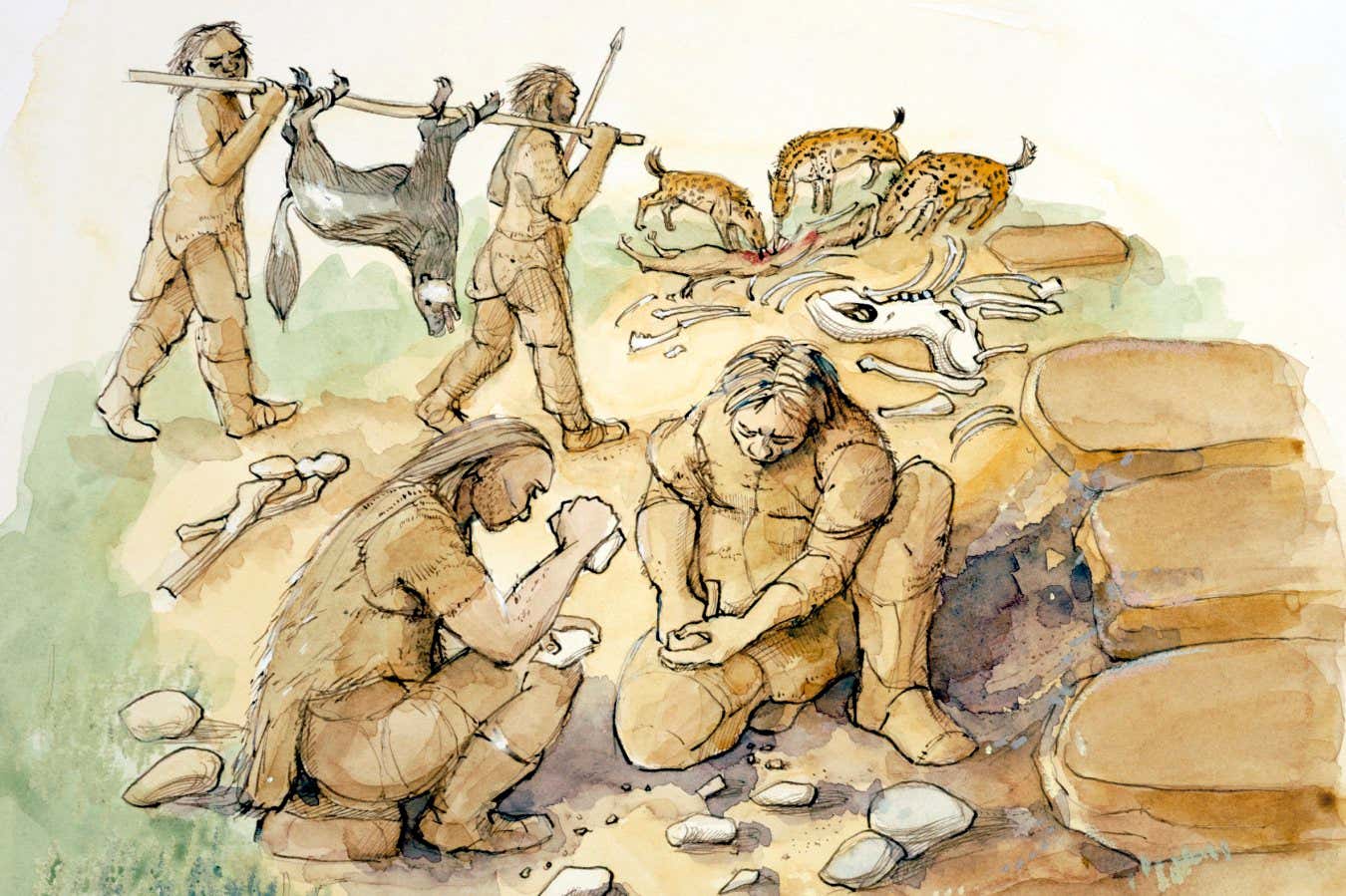
As technology progressed, humans also got better at passing on skills to others
English Heritage/Heritage Images/Getty Images
An analysis of more than 3 million years of human evolution shows that communication and technology developed in lockstep. As ancient humans came up with more advanced stone tools and other technologies, they also improved their communication and teaching skills, in order to pass their newfound abilities onto the next generation – and this enabled more technological progress.
“We have a scenario for the evolution of the mode of cultural transmission in human evolution,” says Francesco d’Errico at the University of Bordeaux in France. “It appears to be a co-evolution, between the complexity of the cultural trait and the complexity in the mode of cultural transmission.”
One distinctive feature of humans is that we have developed increasingly complex tools and behaviours. For instance, ancient humans created sharp stones that could be used for stabbing and cutting, then attached them to wooden sticks to create spears – a technique known as hafting.
Crucially, we can tell other people how to perform these behaviours. In the most complex cases, like playing the violin or programming a computer, this can involve years of teaching and practice. But in the distant past we weren’t as good at passing on information – especially before complex language arose.
With Ivan Colagè at the Pontifical University of the Holy Cross in Rome, Italy, d’Errico set out to track how our ability to transmit cultural information has developed over the past 3.3 million years, alongside our changing behaviours and technologies. They tracked 103 cultural traits, including specific types of stone tool, ornaments such as beads, pigments and mortuary practices such as burials and building cairns. They identified when each trait first appeared regularly in the archaeological record, suggesting it was common practice.
The pair also assessed how difficult each trait was to learn. Some, such as stone hammers, are pretty simple. “You don’t need that much explanation,” says d’Errico. However, the manufacture of more complex tools might need to be demonstrated, and the most complex behaviours – especially things like burial that have profound religious significance – require explicit verbal explanations.
To break this down, d’Errico and Colagè looked at three aspects of learning. First, spatial: can you learn the skill by watching from a distance, or do you need to be close enough to touch? Second, temporal: is one short lesson enough, or do you need multiple sessions, perhaps focusing on different steps? And third, social: who learns from whom?
The pair assessed all the traits themselves and also asked a panel of 24 experts for their assessments. They largely agreed. “We think that the answers are relatively robust,” says d’Errico.
The new work suggests there were two major shifts in cultural transmission. First, around 600,000 years ago, ancient humans were overtly teaching each other, although not necessarily using spoken instructions: gestures may have been enough. That is well before the origin of our species, Homo sapiens, and coincides with the emergence of hafting.
Then, between 200,000 and 100,000 years ago, humans developed modern language. This was necessary because they were performing behaviours like burials. “This involves many different steps, and also you have to explain why you do that,” says d’Errico.
“The link between cultural transmission and cultural complexity is robust,” says Ceri Shipton at University College London. He adds that, while there is much uncertainty about when humans developed language, the new estimate is “a reasonable timeframe”.
Topics:
