

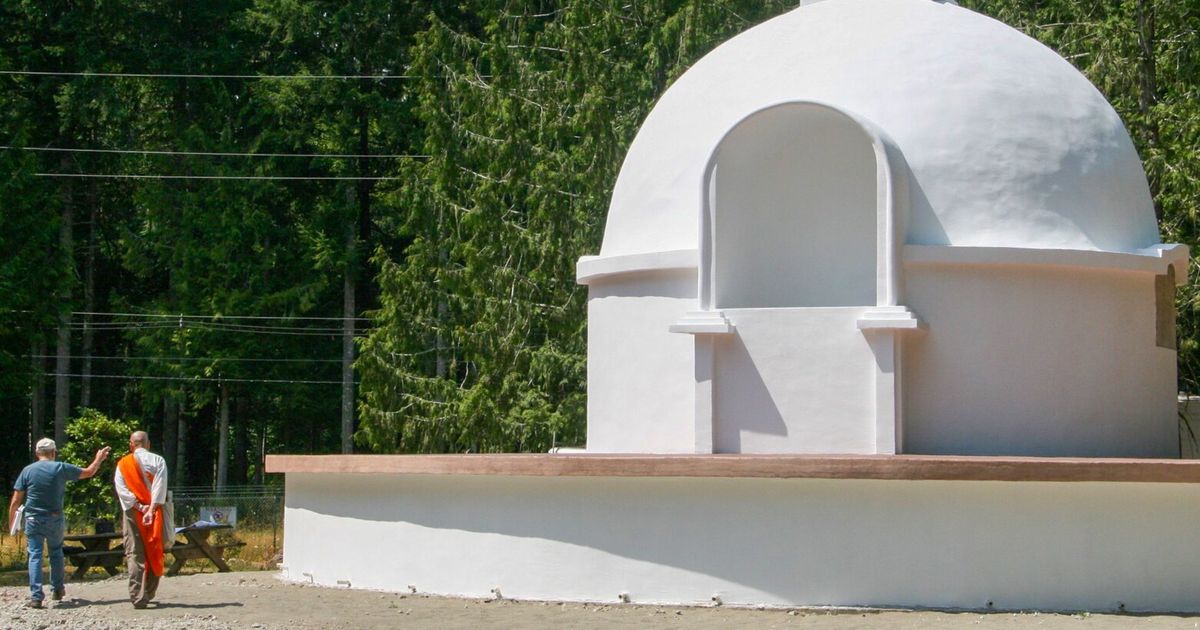
About a year before his death in 2023, I got a chance to interview the legendary whistleblower Daniel Ellsberg over Zoom, chatting with him from his home office near Berkeley, Calif. The topic was global nuclear war. But my interest as a journalist was quite local: Activists were building a Buddhist peace pagoda near one of the nation’s largest deployed nuclear stockpiles, tucked into Hood Canal.
Ellsberg, who died of pancreatic cancer at 92, is best known for revealing the Pentagon Papers to a public kept unaware of an unwinnable conflict in Vietnam. But I was interested in his time as a nuclear war planner and how he ultimately parted ways with prevailing American policy and became a champion, like those activists, of disarmament.
If U.S. strategy is mistaken, I asked him, how did he square that with the successful avoidance of the use of atomic weapons, since those dropped on Hiroshima and Nagasaki in August 1945?
“Nuclear weapons have been used many times,” he replied. “Just as a bank robber threatens a teller with a gun, it does not mean the gun was fired. But with the threat also comes the risk of someone actually pulling the trigger.”
To his point, President Donald Trump on Aug. 1 ordered U.S. “Nuclear submarines” to reposition in response to a public warning from former Russian President Dmitry Medvedev. Medvedev, now deputy chairman of Russia’s security council, said the president’s ultimatums toward his country over Ukraine were “a step towards war” between the U.S. and Russia.
It was merely the latest tit-for-tat of words that somehow feels routine, despite their doomsday implications. Most Americans have grown callous in the face of such bluster and probably give the prospect of an actual nuclear war little thought. Yet these long-developed, ultimate weapons are foundational within the country’s national security apparatus.
“Strategic deterrence,” as longstanding U.S. policy is formally known, is pretty simple: Any enemy that dares try using a weapon of mass destruction against the U.S. is assured swift and severe retaliation.
Proponents argue that has kept America safe through the Cold War and beyond. The portion of bombs and missiles kept on hair-trigger alert are a necessity in a dangerous world; perennial showdowns with countries like North Korea are inevitable and require the appropriate firepower.
But other nations, including China, keep building up their own arsenals. There’s little in the way of international treaties that attempt to rein in a new arms race. The U.S. is itself in the midst of a trillion-dollar modernization of its air, sea and land-based weapons systems over the next decade. Yet those upgrades rarely make headlines.
‘Reminder that peace is possible’
Ellsberg dared to ask: Is there any way out of this entrenched policy?
A tenacious group of anti-nuclear activists near Poulsbo thinks so. Quietly, they are building a monument they hope inspires new generations to believe disarmament can still happen. The Pacific Northwest Peace Pagoda, rising in a cedar grove adjacent to Naval Base Kitsap-Bangor, is nearly complete and will be dedicated next year.
“It’s a reminder that peace is possible,” said Glen Milner, a longtime volunteer for the group known as the Ground Zero Center for Non-Violent Action.
The 30-foot-tall pagoda is among more than 80 such pearl-white structures the Nipponzan Myohoji, a sect of Buddhist monks advocating for world peace, has built across the globe.
This pagoda isn’t meant to be grandiose. It’s all about the location — within a few miles of the home of one of the largest U.S. deployed nuclear weapon stockpiles. Each submarine in the ballistic missile force that deploys from nearby Hood Canal is capable of unleashing 1,000 Hiroshima-sized bombs anywhere the president orders.
The pagoda project, envisioned by the Japan-based sect’s leaders more than four decades ago, has faced opposition throughout its design and construction. In 1982, a religious shrine at the site was burned down by arson, yet the crime was viewed as “potentially embarrassing” to the Navy and never solved. Three years later, Kitsap County denied an application to build the pagoda.
The Ground Zero Center and the monks waited but never gave up on the desire to build it. Today’s county leaders have accepted the project. While more work remains, including the addition of a spire and life-size Buddha statue, the activists are planning a dedication in spring of next year.
“This is the embodiment of the goodness of the American people,” said the Rev. Senji Kanaeda, a monk who for more than two decades has vowed to complete the pagoda project at Ground Zero. “And their courage in standing against oppression.”
Perhaps this all sounds hopelessly naive. But that’s not the point, Kanaeda says. He used the analogy of the dandelion — a resilient species that refuses to give up. Like the flower’s parachute-like pappus, which carries thousands of seeds in the wind, the pagoda’s message will spread, awakening a new generation who might today be numb to the concept of mutually assured destruction.
‘A room awash in gasoline’
The dawn of the nuclear age culminated with the decimation of the Japanese cities of Hiroshima, on Aug. 6, 1945, and Nagasaki, on Aug. 9. At least 170,000 people were killed in the two bombings 80 years ago this month.
Later, the dangerous arms race between the U.S. and Soviet Union brought the world to the brink of nuclear Armageddon on multiple occasions, though the two nations ultimately committed to treaties that reduced their nuclear forces.
Today nearly all those accords have lapsed. New players, including an Iranian regime bent on gaining access to a bomb, make the situation even more perilous. And Russia and the U.S. are investigating and integrating new weapons systems for battle that raise the stakes further.
To expect an end to nuclear weapons in the current geopolitical landscape may be far-fetched. But there are sensible and reasonable steps nuclear states could make, at a minimum, to curb excesses that create unnecessary dangers. At the height of the Cold War, arms talks and agreements made the world safer. Might “tariff man,” Trump himself, consider some arms reduction talks that could slow the snowballing?
The president has signaled he wants to extend the New Strategic Arms Reduction Treaty, the last nuclear weapons agreement between the U.S. and Russia. Originally signed by President Barack Obama and Medvedev — the guy who leveled that ominous warning last month — the treaty limits the two countries to deploying a maximum 1,550 strategic warheads on 700 intercontinental ballistic missiles, bombers and submarines. The pact expires in February, but relations between the two countries continues to sour by the day.
Our leaders shouldn’t give up on a more peaceful future. There are no winners in nuclear war, after all. Untold numbers of people would die — from the attacks themselves, to the widespread famine that scientists expect would follow depending on the scale and reach of the actions.
Ground Zero Center activists believe even an accident with a weapon is only a matter of time. The astronomer Carl Sagan once described the nuclear buildup as akin to “a room awash in gasoline” where one enemy has 9,000 matches, the other 7,000. Such volatility means mistakes will continue to be made.
Perhaps we’ve all become too numb to the dangers. The peace pagoda project — and those who’ve persisted to make it a reality — stands as a fitting reminder nuclear war does not have to be inevitable. Let’s hope leaders around the world, including in the U.S., can reduce the risks before it’s too late.
