

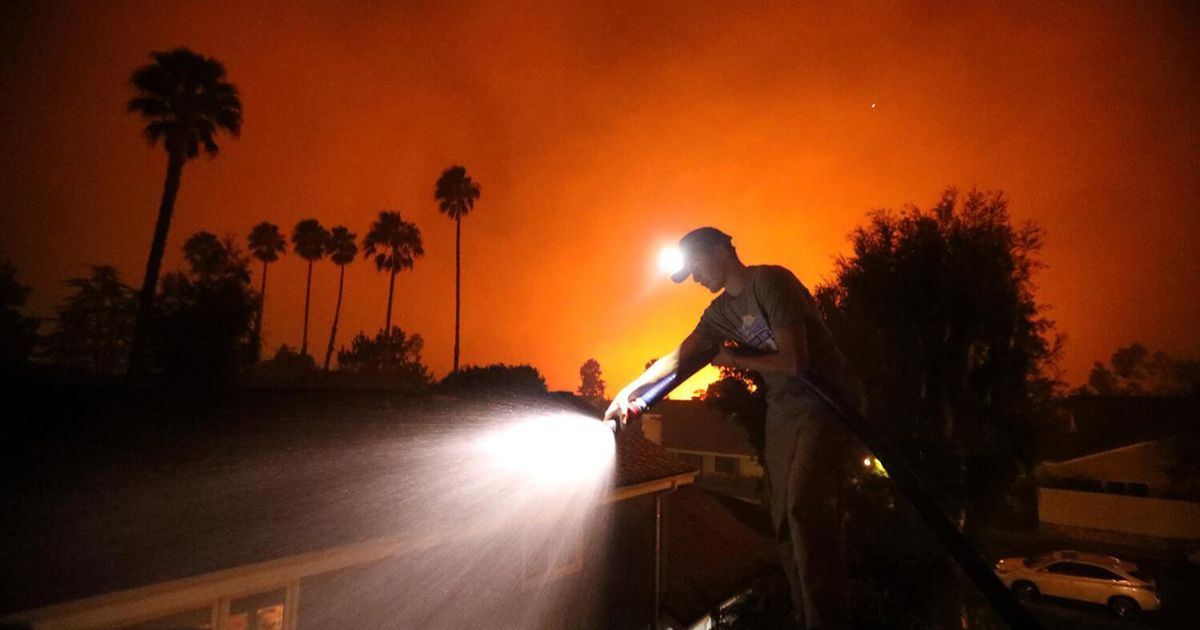
In the immediate aftermath of the devastating Eaton and Palisades fires, local water agencies have been questioned and criticized about why sufficient water resources may not have been available for the fire suppression effort.
As the general manager of a public water agency, I’ve tried to succinctly explain the quandary facing water systems, especially those whose infrastructure has evolved over the past 130 years from irrigating citrus orchards to serving highly populated and dense residential communities.
One metaphor has seemed to resonate. When I talk to people about the finite capacity of water systems, I ask them to imagine a small coffee shop that sells 200 to 300 cups of drip coffee on an average day and a few days a year might sell 400.
That is how community water systems are designed to operate. The random, but not system-shocking, 400-cup day is similar to what a water system may experience on a day with high customer demand in addition to a few isolated structure fires or a small wildland-urban interface fire that is primarily suppressed by air attack resources. Water systems are designed for this scenario, and they perform well.
At that imaginary coffee shop, if one day someone comes in and orders 40,000 cups of coffee, that order simply can’t be filled. There aren’t enough beans, cups, people to make it, people to serve it. That 40,000-cup order is similar to the demand on water systems during the ground response to the Eaton and Palisades fires in early January.
For that coffee shop to be able to fill an unexpected 40,000-cup order that might happen once every 30 years, the business would need to occupy a much larger space, have dozens of people on staff standing by, maintain idle equipment and keep a huge inventory of coffee on hand, most of which would expire and be thrown away.
Building a business plan for a coffee shop that can handle this is theoretically possible, but for 99.99% of the time when demand is not extraordinary, it probably would have to sell coffee for well over $100 a cup to stay afloat.
Customers would be paying a huge sum for their daily coffee so that the shop could be ready at any moment to fulfill a 40,000-cup order. People don’t like to pay for so much excess capacity; in general, they probably shouldn’t. In the coffee shop example, if prices were set to support that vast spare capacity, customers wouldn’t go there, and the shop would close.
Public water systems can’t close. We provide safe drinking water at your tap, on demand, every minute of every day. If being prepared for the 1 out of every 10,000 days scenario is what the public demands, that capacity can be built. However, the upfront and ongoing financial investment is larger than any community can likely tolerate. People would move away — or, here in California, reject the rate increase that would be required.
Our state’s Proposition 218, approved by voters in 1996, allows for ratepayers to protest and reject water fee increases they don’t want, and the public exercises that power frequently. The average household water bill in California is approximately half the average household cellphone bill. The people have spoken, and they want low water bills.
Building a system that has the capacity for a catastrophe that may occur every 30 years is possible, but I don’t believe it’s the best use of public and personal resources.
Yes, public water systems should continue to invest in emergency preparedness and resilience measures. Yes, we should upgrade our aging and obsolete infrastructure. Yes, we should reexamine the way our legacy exurban water systems have and haven’t adapted to the current needs of their higher-density residential customer base.
But we should also acknowledge that a better return on our community investment most likely will come from hardening our homes through proven tactics that make them less ignitable and through being committed to the maintenance of defensible space to prevent rapid fire spread.
Water will always be needed for firefighting too, but it’s not realistic to imagine water systems will ever be equipped to douse fires as intense, and widespread, as the Eaton and Palisades blazes were at their peaks. Creating and maintaining that capacity would simply be too expensive.
The good news is that the more pragmatic solution is relatively affordable: applying the inexpensive prevention techniques we already have and continuing to develop new ones.
