

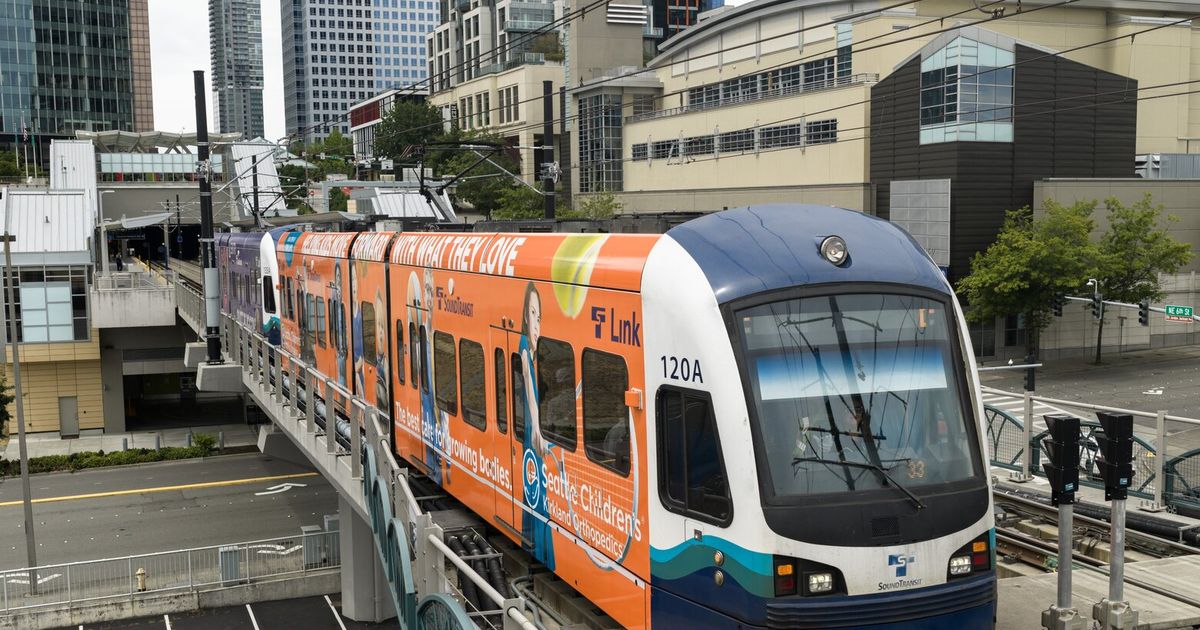
When Bellevue’s Crosslake light rail connection opened in March, critics warned that it would bring crime from Seattle to Bellevue. Did this actually occur? Might it occur with the upcoming West Seattle expansion, where I live and hear similar concerns? It did occur in Washington, D.C., according to a 2015 study by Phillips & Sandler.
But Seattle is not D.C. I wanted to find out what happened in Bellevue, so I downloaded all the recent crime data provided by Bellevue police. The picture is mixed: Crime rates fell after the light rail opening — vindication for public-transit supporters like myself. But it’s not a total win: Crime fell by less in the areas right around the light rail stations.
What do we see? Bellevue crime is down a lot over the past two years, in ways unrelated to light rail. Comparing December 2023-February 2025 against the same period two years later, December 2025-February 2026 (just before the link opened), the mean number of incidents per month dropped from 740 to 506. How about after the Crosslake Connection opened? Crime didn’t rise; it actually dropped further. The mean from April-June 2026 was 483. This doesn’t mean that the Crosslake Connection reduced crime. It’s probably just a continuing downward trend. But any impact must have been small enough that overall crime still dropped. Certainly there was no big spike in crime.
Maybe the light rail only brings certain kinds of crimes? I combined all the different types of crimes in the Bellevue PD data into five categories (violent crime; property crime; drug and alcohol offenses; public order offenses; and other). Comparing the three months since the Crosslake Connection opened (April-June 2026) against the same April-June period in 2025, violent, property, and drug and alcohol crime are all down 15%-30%, and “other” is flat. Public order offenses have risen by about 33%, although the initial spike occurred in February 2026, before the connection opened, and also this is a rise in the monthly average from 19 to 25 — a big rise percentagewise but not in absolute terms. Property crimes, the biggest in terms of number of offenses, fell from 315 to 258.
We cannot conclude that the light rail is responsible for increased crime rates in Bellevue, since crime rates did not increase. But maybe rates would have fallen further without the Crosslake Connection. We can consider that possibility by comparing how crime changed near the Bellevue light rail stations as opposed to farther away. We do see something here. Comparing April-June 2025 vs. 2026, crimes within one mile of the stations (roughly, the distance from the north light rail station to Uwajimaya) dropped by only 3.4%, compared to a drop of 19% outside that radius, a 15-percentage-point gap. But this pattern predates the Crosslake Connection. Comparing December 2024-February 2025 against December 2025-February 2026 (just before the light rail opened), crime that occurred within one mile dropped by only 21%, while farther away it was 28%, a 7 percentage point gap, or 8 percentage points smaller than the post-light-rail gap.
The fears of crime are, to some extent, justified. While crime rates dropped across Bellevue, the drop was slowest near to the light rail stations. Given that improvement was already slower near the stations before the Crosslake Connection, it’s hard to tell how much blame the connection can take for slower crime reductions, although it could reasonably take the blame for some. But taking in the bigger picture, the worst negative effect we can justify was still small enough that crime rates didn’t actually rise. We have to start splitting the data to find anything at all.
In weighing the impact of a crime bump that seems quite small against the benefits of increased light rail access between two major King County population centers, to me it seems that the benefits win out, and these numbers reassure me about the potential impacts of the eventual extension of light rail to where I live in West Seattle.
