

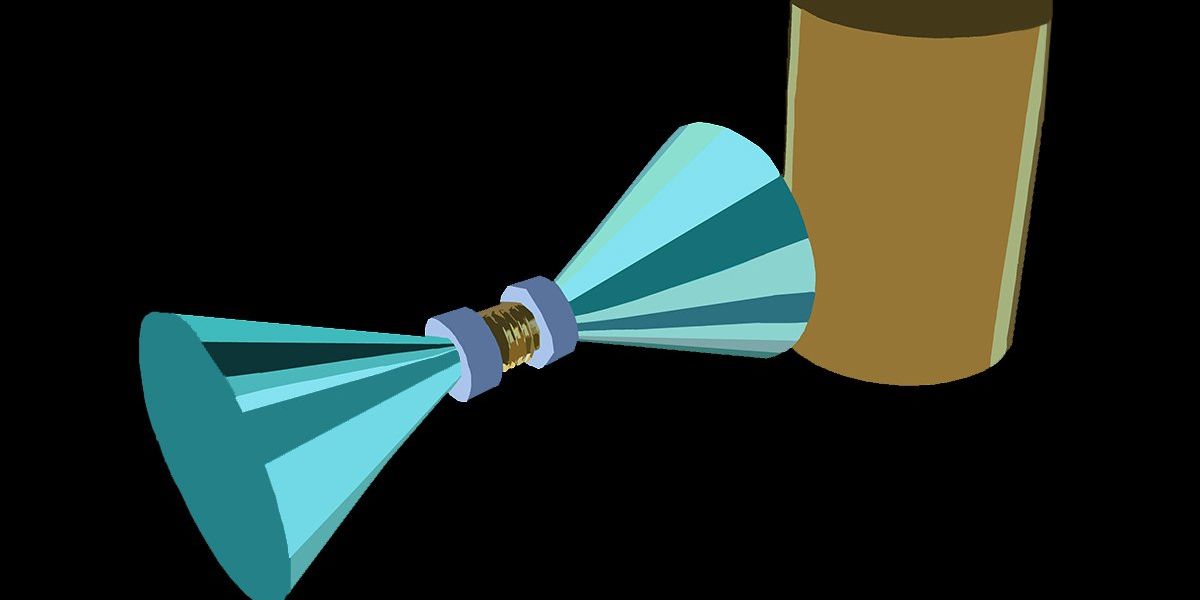
There are plenty of labs working on solutions to Kessler Syndrome, where there’s so much debris in low Earth orbit that rockets are no longer capable of reaching it without being hit with hypersonic parts of defunct equipment. While we haven’t yet gotten to the point where we’ve lost access to space, there will come a day where that will happen if we don’t do something about it. A new paper from Kazunori Takahashi of Tohoku University in Japan looks at a novel solution that uses a type of magnetic field typically seen in fusion reactors to decelerate debris using a plasma beam, while balancing itself with an equal and opposite thrust on the other side.
Researchers have been working on two main categories of systems for the type of deorbiting work that might save us from Kessler Syndrome—contact and non-contact. Contact systems physically make contact with the debris, such as by a net or a grappling hook, and slow the debris to a point where it can deorbit safely. This method faces the challenge that most debris is rotating uncontrollably, and could potentially destroy the satellite trying to make contact with it if it move unexpectedly—adding to the problem rather than solving it.
Therefore, non-contact forms are in the ascendancy, as they allow a system designed to deorbit another satellite to stay a few meters away while still affecting its speed. Typically they use systems like lasers, ion beams, or in the case of Takahashi’s invention, plasma beams, to slow their intended target to a point where it can safely deorbit. The problem with plasma beam-based deorbiting systems is Newton’s third law—as the plasma is being directed toward the target, it is pushing the operational system away from the defunct one, essentially acting as a small plasma thruster. As the distance between the two increases, the slowing effect of the plasma decreases. To solve this problem, Takahashi and his fellow researchers presented a bi-directional thruster in a paper in 2018 that counteracted the pushing force of the plasma used to slow the target with an equal force in the opposite direction, allowing it to maintain its position.
Advancements in Plasma Thruster Technology
However, in that original paper, the thrust was too weak to effectively deorbit some of the larger potential targets for such a mission. So Takahashi set about improving the design by implementing a “cusp-type” magnetic field. These are typically used in fusion reactors to ensure the plasma doesn’t interact with the wall of the magnetic chamber. The cusp of a magnetic field is a point at which two opposing magnetic fields meet and cancel out, creating a quick change in direction for the forces they apply. Ideally, this results in a stronger plasma beam.
That is what happened when Takahashi set up an experiment to test the new cusp system with the previous “straight-field” system that had proved too weak. He saw a 20 percent improvement in the force that the plasma thruster exerted on the target, resulting in a 17.1 millinewton push at the same power level. When he bumped up the power level to 5 kW (compared to the 3 kW in the original test), it showed an improved deceleration of about 25 mN, which is approaching the level of 30 mN expected to be needed to decelerate a 1 ton piece of debris in 100 days. It also had the added benefit of using argon as fuel, which is cheaper compared to the xenon typically used in plasma thrusters.
Even with this success, there’s still a lot of work to do before this becomes a fully fleshed out system. The experiment was run in a vacuum chamber, with the plasma thruster only 30 centimeters away from the target, compared to the meters that would be required in a real orbital environment. In fact, the debris target will also move in comparison to the deorbiting system as it slows down, so it will have to strike a balance of maintaining distance from a slowing object as well as continuing to fire the decelerating beam at it. And finally, there is the disadvantage of it using literally twice as much fuel as other solutions that don’t require thrusters operating is opposite directions—while fuel might not be much of a concern for plasma thrusters, operating one over 100 days is sure to consume a lot of it.
With all that being said, any new solution to this potentially catastrophic problem is welcome, and Takahashi will likely continue work on developing this prototype. Someday soon you might even be able to watch a dual-thrust plasma engine blasting away at a large piece of space junk.
From Your Site Articles
Related Articles Around the Web
